
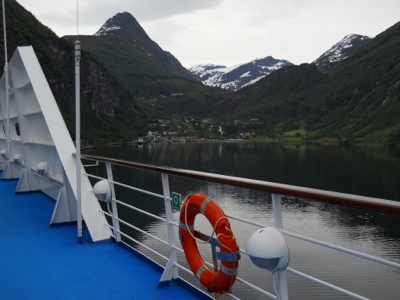
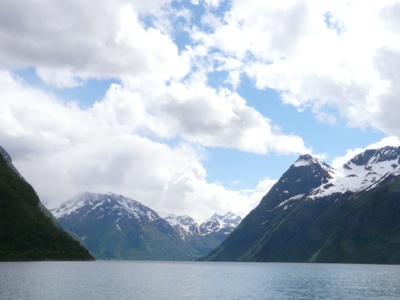
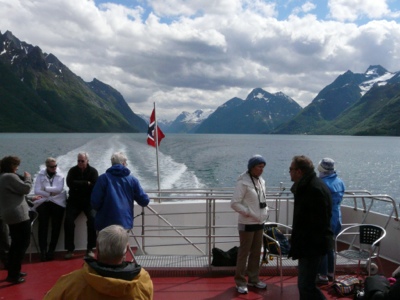
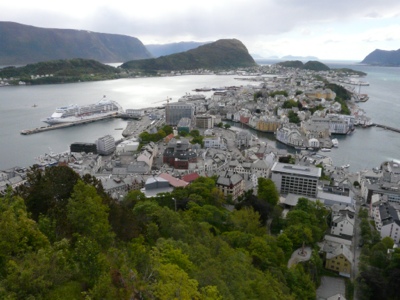
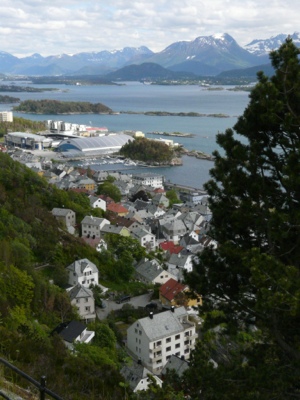
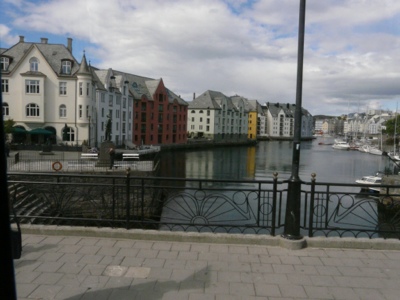
Our introduction to Norway was spectacular. We have travelled down a fiord. Surrounded by snow capped mountains which form high walls on both sides. Our first stop is the art deco town of Alesund. This city of 45,000 was rebuilt in the art deco style after burning down in 1904.
Gary and I took a small boat tour on the fiord. We passed many recreational homes, boat houses with rooms above, many small islands, boat building facilities, dry docks and fishing plants. The main source of income is still fishing and fish farming. Cod, salmon, trout and halibut are all farmed. There is also gas and oil associated technology.
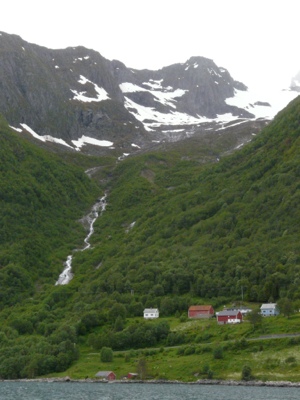
All electricity is produced by water driven turbines. There are a very large number of waterfalls, which also provide the drinking water. At this time of year the melting snow creates many of the waterfalls. However, the west coast of Norway is the wettest area in Europe with only 10 days free of rain most summers so the waterfalls are continuous.
Norway has 930 working tunnels on its roads, 30 of theses are under the sea. While they often make the roads shorter they are mainly for safety. Avalanches, both rock and snow are regular occurrences. While the avalanches can be deadly the resulting tsunamis have claimed many more lives over the years.
Again we hear about the moderating influence of the gulf stream. It also contributes to the fishing industry by providing a feeding ground for krill and other small fish.
There are still a number of buildings with sod roofs. This is a very economical building technique. The roofs last for a very long time, are basically maintenance free, provide excellent insulation and are cheap to build.
On our transit to Norway we passed about a dozen oil and gas platforms (we understand there are many more in the area). The Norwegian oil fund is the largest fund in the world. Norway has a population of 5 million, children study English starting in grade 1 and are required to choose a third language to study in grade 3. Medical care is free, taxes are high, unemployment is 2.4%.
The whole area we have been visiting honor their Norse background with a summer celebration on June 23. In some area we heard about burning a symbolic Viking ship, in other area a hugh bonfire, with drinking and festivities until early morning. This is the longest day and after that the days start getting shorter until night returns in August.
Alesund is a town built on several islands at the mouth of the fiord. Geiranger is at the furthest point inland along the fiord. Geiranger is a town of 270 residents and about a million tourists. There are 4 cruise ships in the bay with us and this is not yet the busy season. There are only 2 roads out of town and one is closed in the winter. Maureen and I took a bus trip up this road to the top of a nearby mountain. It is a one lane road up a steep mountain with many switch backs and 2 way traffic. There are no rules as to which vehicle gives way and backs up to a wider area of the road, drivers figure that out each time it happens.
We passed a number of bicyclists on the trip up the 1500 meter high mountain. By the time we reached the top it was snowing and we were blinded by the clouds. Near the top we passed through tunnels created by the snow banks on both sides that towered above the bus. We did not see any skiers, at this time of year skiing is popular, but there are no lifts. If you want to ski, you hike up and carry your skis or walk up on your skis with skins.
We passed fiord farms, basically used to raise cattle, the farms operated only in the summer as it is too dangerous to be in the mountains in the winter due to the number of avalanches.


Thank you so much for the wonderfully descriptive journal of your travels. It is a new venue to me so I am enjoying reading your remarks and seeing the wonderful pictures. Enjoy the rest of your trip.
Jenny & Bob