
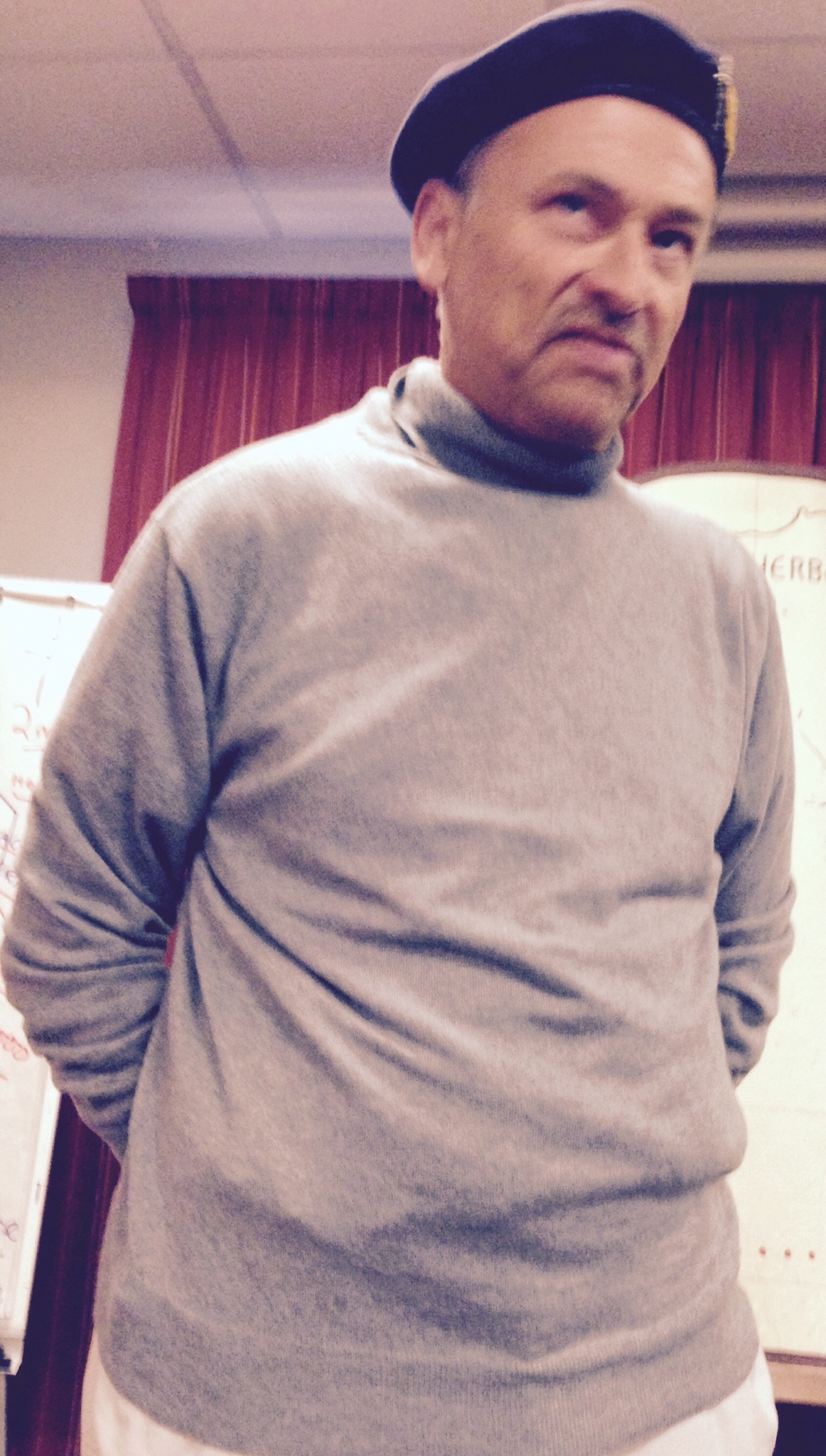
Last night our group had a lecture given by Monty, the Commander of the British and Canadian Forces. He was actually a WWII lecturer who came into the room and delivered a speech that Monty had given to the Allies Forces commanders on the eve of D-Day. He then gave us an overview of the D-Day operation and events leading up to it. He does an excellent imitation of Monty and of Churchill. So as we go through the day we hear from both of them at times.
Juno Beach is a 5 mile stretch of the coastline. Today it was calm, sunny and warm. We walked on the beach, looked at the various monuments, inspected a German bunker and visited the Canada Centre.
Some points of interest I learned today
– every Canadian that served overseas during the war was a volunteer (I think I knew that but had forgotten).
– when Canada entered the war we had 13 warships, 275 aircraft, 29 machine guns, 2 light tanks; by the end of the war Canada had the 3rd largest navy in the world, 4th largest Air Force
– one half of all eligible males in Canada fought in WWII
– one half of all Canadian Air Force crew were killed, an additional 25% are injured or taken POW
– while there were years of planning for the invasion, there were many things that went wrong in the first few days
– the plan was for the Air Force to fly the length of the beaches dropping bombs to create fox holes that the landing forces could use for cover, the weather was overcast and the bombs were dropped too far inland to be of any help
– paratroopers were to drop in by midnight to disable the bridges and roads leading to the beaches, there drops were not on Target and they were scattered instead of in their groups
– some of the landing barges stopped in water too deep and soldiers lamented with 70 lb packs walked off into water over their heads
– some of the tanks being landed ended up in deep water are are still there today
– some soldiers arrived with collapseable bikes that helped them get around faster
Why the Allies were able to surprise the Germans. Our lecturer provided a number of reasons why this happened
– the logical place to land would be a port that is close to England, e.g. Calais where there is a port that could be used for the necessary supply line to support the advancing army and where the channel is only 21 miles across.
– so they choose a place that is not logical and set out to solve the many problems this creates
– the Bay of the Seine is chosen because it is 100 miles across from England, there is no port that could be used for the supply lines and it is far away from Calais where they know the Germans are preparing for them
– there is a series of events set up to reinforce the German belief that the invasion will come at Calais
– the Brits got hold of the German code (enigma) and were able to monitor what the Germans were planning
– there was a double agent who was so good he received the Iron Cross from Hitler and the Victoria cross from the Brits many years later, he fed information to the Germans re Calais as the target. He was run by MI6 and the xx committee (double cross but known as the 20 committee)
– the Brits set up a fake building program in an area in the south of England to look like it was targeting Calais
– Hitler believed there was no point in fortifying areas where there was no port (the allies knew this)
– to solve the supply issue the allies developed portable ports, these were built in Southhampton in pieces and towed over, assembled in place and then protected with a breakwater created by sailing over large ships, turning them broadside to the beach and sinking them (idea credited to Churchill)
There were daily objectives for the ground troops but these were not met. The initial objective was Caen which took 3 months to reach. Once there the front opened up and the rest of the German resistance was overrun more easily.
After our visit to the beach we visited Canada House, a house often seen in pictures of D-Day and then the Canadian War cemetery. Our last stop is the Ardenne Abbey where 27 captured Canadians were killed on the orders of Sargent Kurt Myers.
For D-Day to be successful the Allies first had to master the sea and the air. Deippe was considered by some to be a test to see if the Allies could take a port and to identify the issues they would need to resolve. But there is some thought that it was a cover for an attempt to steal the German machine “Enigma” and / or to discover more information on the German defences.
Tomorrow we have a day off and a lecture in the evening about the French Resistance.


 travel70