March 1 Taiwan pictures

March 1 KeeLung, Taiwan

KeeLung is a fishing port north of Taipei. Today we took a tour to a gold
mining area and along the north coast. KeeLung means Bird Cage. It is a natural harbour and was used for many years as a fishing harbour, now it is the second biggest wholesaler for fish. It is a city of about 400,000 population and is 20 miles from Taipei. The total population of Taiwan is 23 million. The population is decreasing as people are getting married later (30s) and having only one child on average.

Our guide was a very energetic man of 63, he originally trained as a diamond cutter and worked in South Africa for many years, he then moved to White Horse, his son is currently going to school in Kamloops studying business. He didn’t think this was a good idea and has told his son he would be better off to come home and be a tour guide. Since Taiwan has started allowing Chinese into the country in 2010 their tourism had gone from 1.5 million tourists a year to 5 million.

It is very foggy and rainy today. Apparently it rains 250 days a year. It is spring here and we saw some lovely Cherry blossoms. We also saw MacDonalds. Our guide told us there are 350 MacDonalds in Taiwan (he thinks MacDonalds is great and eats there once a week). He also talked about shopping at Costco and about KFC.

The Japanese occupied Taiwan for 51 years from 1895 until 1945. Around 1949 China became under the influence of Russia and the communists took over and Chiang Kai Shek came to Taiwan, bringing 600,000 soldiers and train loads of treasures. Over the next number of years 3700 ships each with hundreds of refuges arrived from China. 

A gold rush started in this area in 1907 when the Japanese discovered gold in the area. It became a major mining area for gold, copper and coal. The mines are all closed now. The gold has run out and the coal mines were closed after a series of accidents claimed the lives of over 100 miners. Taiwan now uses coal imported from Australia, USA and Canada to generate electricity, which is very inexpensive here.

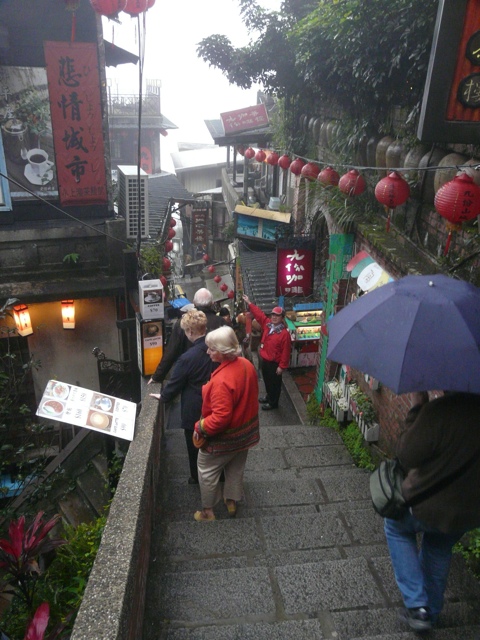
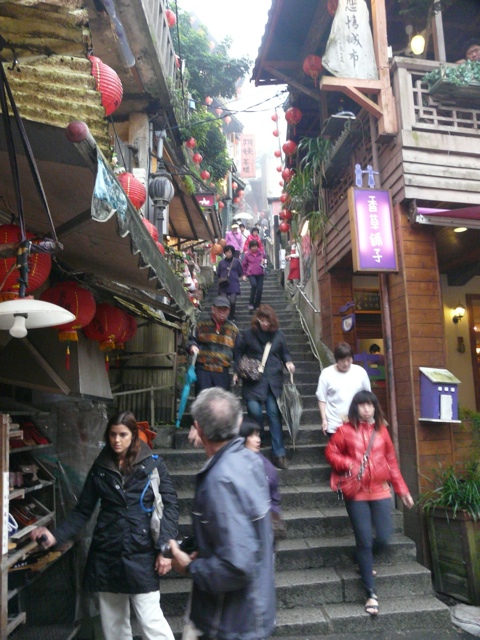
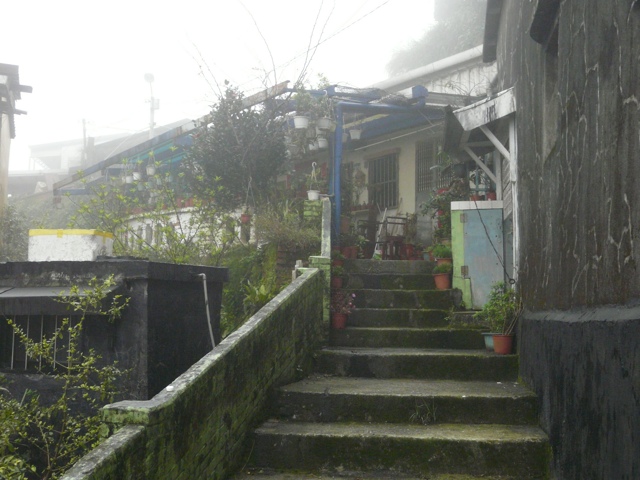
Our first stop is in the town of Joiu Fen. It used to be a mining town and became a ghost town when the mines closed. Then a famous Chinese director made a movie about the town – City of Sadness. The movie can still be seen on Utube. As a result of the movie the town became a tourist town and several hotels and restaurants have sprung up. We went for a walk in the market and down the many, many stairs. Why do such little people have such high steps? The market was very clean. Our guide went along the booths sampling all the dishes – candy, several kinds of tea from the highlands of Taiwan, art, pottery, carvings, leather goods, brushes and paper for Chinese ink drawings. Of course, everything is made in Taiwan. The prices and quality were very good. You could buy good sized hand made leather purses for about $40 Cnd. 

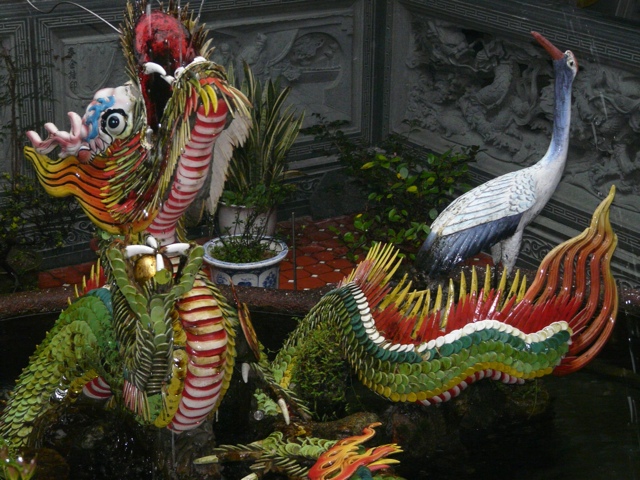
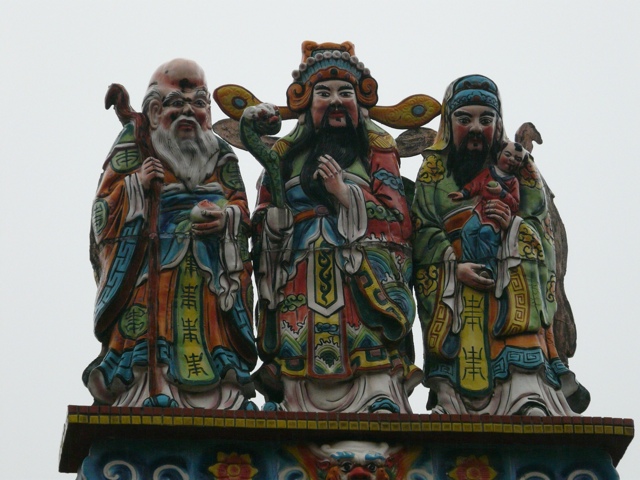
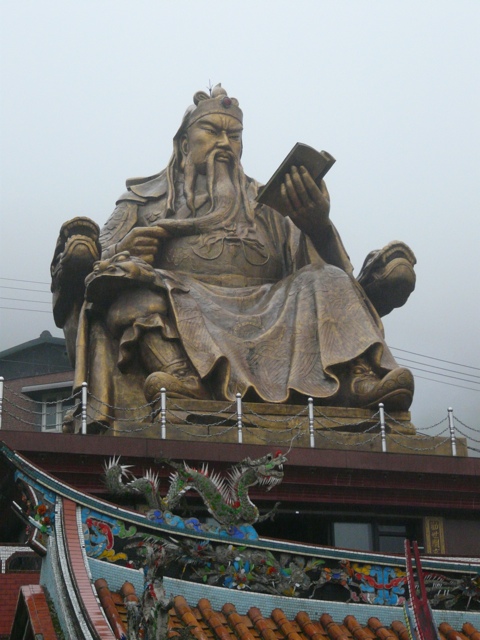
Taiwan has 40,000 temples of which about 50% are licensed. Temples are all supposed to be licensed. 70% of the population are Buddhists. We visited a Taoist temple. The temple was dominated by a huge statue of Mr Qwan Kung. He was a follower of Confucius who lived 2000 years ago and taught loyalty to your customers and masters. He is pictured reading from a book. The temple was built 120 years ago during the Han dynasty. Inside the temple was richly decorated. There is a beautiful fountain with a dragon and two male cranes, a red faced god who is the God of Money. The guide showed us how to ask the god for guidance. He first took some sticks in a jar and spun them 3 times each way, then asked the question and threw 2 pieces of lip shaped wood onto the floor. Depending on how the lips fell determined what the answer is to your question. People come to this god with questions about their jobs, to determine the best date to get married etc.

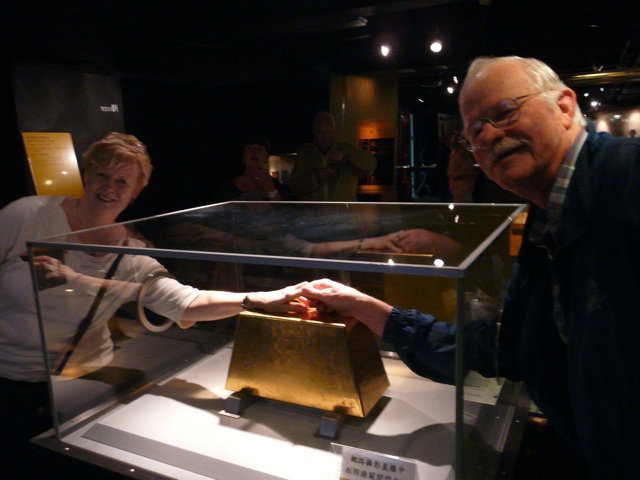
We also visited the Gold Ecological Park. There we visited the museum. During WW II POWs were brought here by the Japanese to work in the mines under terrible conditions that were compared to the holocaust in terms of how the prisoners were treated. While in the museum we saw and touched the largest brick of gold in the world – 2,130kg. The information in the display said that gold is so rare there have only ever been 200,000 metric tons mined world wide. 

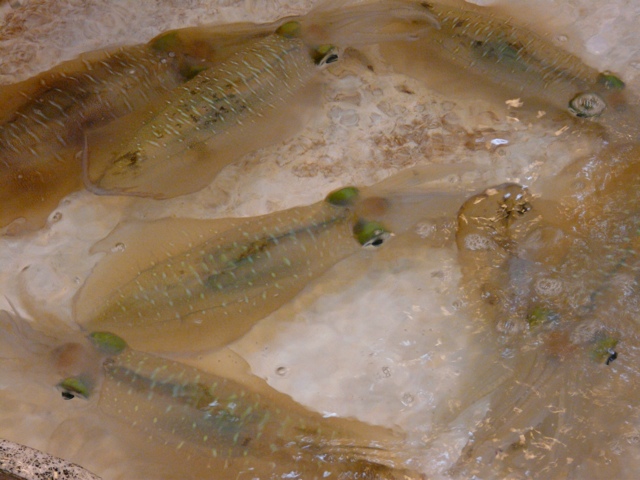
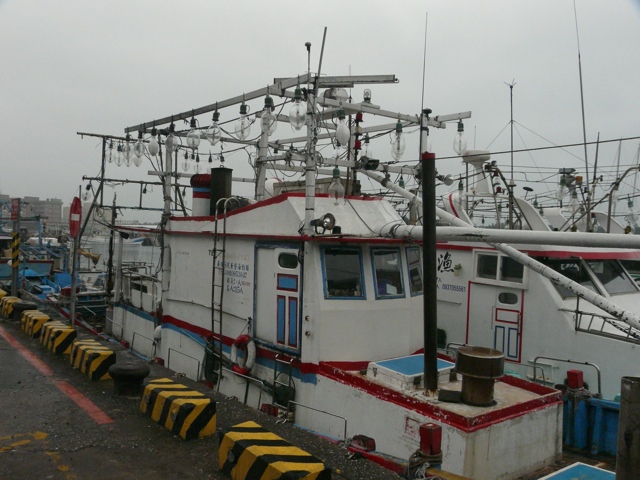
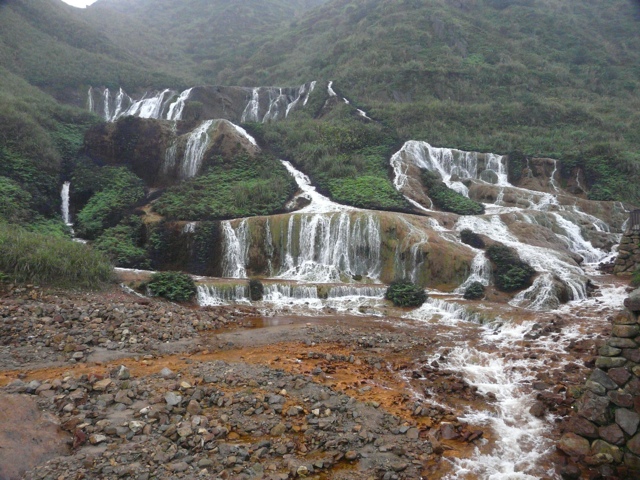
We then drove to the sea. On the way we passed a waterfall and a stream with copper colored rocks – tailings from the copper still in the mountains. Where the river runs into the sea the sea is two colours and so is named EuYung Sea which means two colours, this is also where the China East Sea and the Pacific Ocean meet. We passed through some small fishing villages. The fishing boats are equipped with a lot of lights strung along the length of the boats. They fish at night for squid and use lights to attract the squid into their nets.

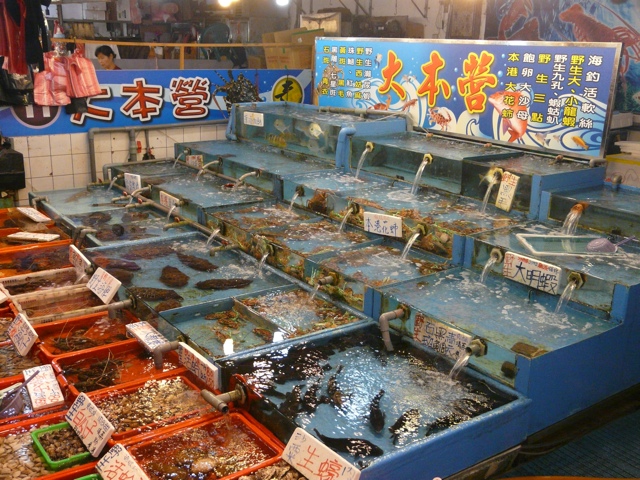
We stop at fish market. All kinds of unusual fish, most alive in tanks, several kinds of shrimp, squid, many varieties of fish we didn’t recognize, a counter filled with large fish eyeballs staring at us – we are told these are a delicacy, blue marlin eyes. We see elephant fish, apparently from Canada (who knew we even had them).

Tonight and tomorrow we are traveling to Japan. According to Japanese laws the ship cannot use it’s satellite communications system, so no Internet until we leave the Japanese waters. It will likely be 3 – 4 days before I can post the Japanese blogs. 
Posted in Uncategorized | 2 Comments

Gary’s Comments

New blogger here…Gary…just thought I would try out this new contraption! A sea day today…time to fool with it. An enjoyable cruise in that we have met more people than usual to interact with on a daily basis. most americans,  but a few Brits, Canadians, and the odd It and Scand. 
Except for Hong Kong, mostly very poor countries…but energetic people, looking to the future with enthusiasm….easy to see why, they are called Tigers, or at least Tiger economies. We are traveling the East China Sea, with much of it disputed ownership…China claims it all, and other countries…Vietnam, Thai, Philippines, Taiwan, Korea, Malaysia, Indonesia all claim part of it. It will take good diplomacy over many years to keep the peace. Meanwhile they all use the sea lanes which do not seem to be all that busy…maybe we as a cruise ship are avoiding? I’ll have to ask a crew member about that.
We are at 23N today, having come from close to equator and it is 17F…very nice…no need of woolies yet! just had my nap…now for a few laps around the deck, maybe a hot tub, beer before dinner…just sailing along!! Cheers to all…G

Posted in Uncategorized | 3 Comments

Feb 26 & 27 Hong Kong and Kowloon

Feb. 26 & 27 Hong Kong & Kowloon

What a difference! As we started our tour Saturday we noticed some significant changes from where we have been. For starters not one motorbike was spotted. They drive on the left, have traffic lights and vehicles stay between the lines! Everywhere we went was clean – no garbage. In fact there were signs posted “please wrap spittle and gum”, fixed fine for littering $1500HK ($210CDN).

Our first stop was at a view point which over looks two bridges which have been constructed to connect the island to the mainland. In 1997 the new airport was opened. A potion of the harbor was reclaimed to create a new expressway. The area reclaimed is 1/3 the size of the original island.

Hong Kong island has a population of 7 million on an area of 78 square meters. There are 260 islands, the largest is Lantau with an area of 144 square meters and less than 100,000 people. The government is trying to preserve Lantau Island in it’s current state. Therefore no vehicles from off the island are allowed. The only vehicles are those which receive permits from the local police. In order to get a permit you have to prove you live or run a business on the island.

We passed a lot of construction on the way. They are building a new rail station for the high speed train that will run between Beijing and Hong Kong. The train will run at 300 – 400 kms an hour and the trip will take about 8 hours.

Hong Kong is financing the new construction, largely by selling property. But they are running out of property and Beijing is apparently warning them they need to find new sources of income. 

Saturday we visited Lantau Island. Because of the restrictions on no vehicles from the mainland we have to change buses at the entrance to the island. The island has few roads and lots of hiking trails. A new town was built to support the new airport, The population is 80,000 – 100,000 and is just outside the restricted traffic area. A 700 square foot unit in this new town would cost $45 million ($650,000 Cdn). 

Lantau island used to be a booming fishing area. However, the area has been overfished to the extent that fishing has been severely curtailed and the young people have left the island for work in Hong Kong. The inhabitants are mainly old retired people. There also used to be farming but that ceased 50 – 60 years ago. All the livestock was released and there are now about 300 cattle and buffalo roaming wild. The government owns most of the land on the island and is currently resisting pressure by developers to sell the land. There are several monasteries and nunneries. There are also three prisons. Most of the inmates are from Hong Kong. We passed one along the way – right beside the ocean, complete with tennis courts, skating rink, swimming pool and basketball court. Seemed like a better place than some of the tenements we passed.

Construction looks like an interesting challenge. They use bamboo scaffolding which is joined together with wire and duct tape. We see this even on the large high rises. The island has good water reserves which is collected from rain runoff. Hong Kong has to import at least half it’s water as there is not sufficient for the population. 

95% of the fish consumed in the area is imported from Philippines, Australia, Malaysia, Singapore. 

Lantau is exactly half way between Hong Kong and Macau. High speed ferries run between the two regularly. Macau sounds like basically a gambling area. During the war the fishing village Tai O was an escape route to Macau as Macau was under the Portuguese which was neutral and thus a way to escape the Japanese.

The main thing we saw was the Po Lin monastery which is home to what is called the big Buddha. Our guide gave the best explanation I have heard of Buddhism. Buddha is a title not his name. He was born 563 BC and died at age 80 in 483 BC. He was born to a royal Hindu family. His name at birth Siddartha Goutman. At the age of 19 he gave up his life as a prince to become a monk. At the time he had a wife and a one year old child. 

There are three emblems that signify Buddhism. One is a flag with four stripes running both horizontal and vertical. The colours are blue, yellow, red and white. Another is three wheels which represent reincarnation. The last is a swastika which is shown in some pictures of the Buddha and is an old Hindu sign 2500 years old. A number of Hindu practices have been continued in Buddhism. The monastery we go to for lunch has a very large Buddha statue it is 24.6 meters high, made of 202 bronze tiles, weighs 202 metric tons. It was built in mainland China in 1986.  The monastery was started in 1907 and the monks spent 60 years collecting sufficient money to build the statue. In 1991 the tiles were moved to Lantau and welded together on site. The Buddha was designed by a Chinese woman from an art college. She had to incorporate certain traditional features of Buddha, such as the hair which represent barnacles (to keep him warm in winter and cool in summer), the long ears, sitting position and hand gestures. The long ears come from the Hindu tradition of piercing the ears of all children at one year of age. The weight of the gold earrings stretched their ears. The longer the ear lobes the richer the family was.

The road leading to the monastery was lined with 12 statues – the 12 Devine generals. Each statue is different and each has a 2 hour time of the day he is responsible for e.g. 9 am – 11 am. Each also represents one of the signs of the zodiac. We then passed through an archway which housed a statue of the Buddha’s main disciple and four guards. We had a vegetarian meal in the monastery and then drove up to the Buddha. There are stairs but I don’t think many of us on the bus would have made it! 

We also visit a traditional fishing village on the island, Tai O. As it was Saturday the market was underway and there were lots of kids and their parents wandering around. The old part of town consists of houses built on stilts over the water, there are a number of bridges connecting the various parts of the island. In the market the main items for sale are live fish and dried fish bladders. There were hundreds of these dried bladders hanging in the various stalls. The bladders are adde to soup, in the hot water they break down and basically act as a thickener. 

We went into a Taoist temple. The original building is 500 years old. Each time it was expanded a stone tablet was put in place detailing who had contributed to the building. This has provided a lot of detail about the families living on the island and their connections.

On Sunday we went for a walk in Kowloon. We visited the Museum of History and a couple of markets. Walked for about 6 hours. The museum was interesting and we learned the history of Hong Kong. One of the markets we visited was the Gold Fish market. About 2 blocks of tiny aquarium shops selling everything to do with aquariums. It was a mob scene. Because it is Sunday lots of families were there. If you wanted to buy some fish you go into one of the shops, get a bucket, scoop some water out of one of the tanks, get a net and scoop out the fish you want – self serve goldfish. The other market we visited seemed to be a general market, you could buy just about anything there, the goods did not appear to be of very good quality. By contrast we passed through an area with some very expensive shops. A lot of jewelry, I was not permitted to enter any of these. Didn’t appear to be any bargains!

Saturday night we ate on the ship in one of the restaurants we had front row seats for the laser light show that is put on every night by buildings on the Hong Kong side. Every meal I think of Dave MacIntosh – there is a chocolate fountain and Dave Cartner – the ship makes it’s own ice cream and it is even better than the Stoney Creek Dairy!

Tomorrow another day at sea on our way to Taiwan.

Posted in Uncategorized | Leave a comment

Hanoi pictures

Posted in Uncategorized | 1 Comment

Feb 24 Hanoi

Feb. 24 Hanoi

Hanoi is built along the Red River, this is another river that has its source in China. The Red River Delta is the second largest in Vietnam. Over half the population of Vietnam are farmers. We pass several rice farms on our way to Hanoi. A number of the farmers are out working today, some with their water buffalo.

Our guide tells us that men have 3 tasks they must perform in their lives. First they must build a house, the houses and narrow, usually 4 – 5 meters wide and 10 – 15 meters long. We see this design in the country and the cities. The second task is to get married. This is important for balance (Yin and Yang) a concept we hear often. The third task is to buy a buffalo. Now, for those no longer working on the farm, the task is to buy a motorbike in order to get to work. The house are built so narrow because taxes are based on the frontage. Most houses operate a small business from the room in the front of the house, either a coffee shop, a store selling one product or a motorbike repair shop.

The original name for Hanoi was Tong Long (ascending dragon). Hanoi means city within the river.

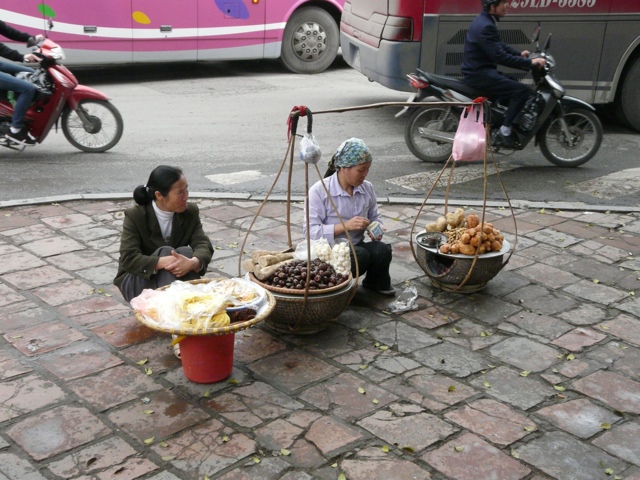
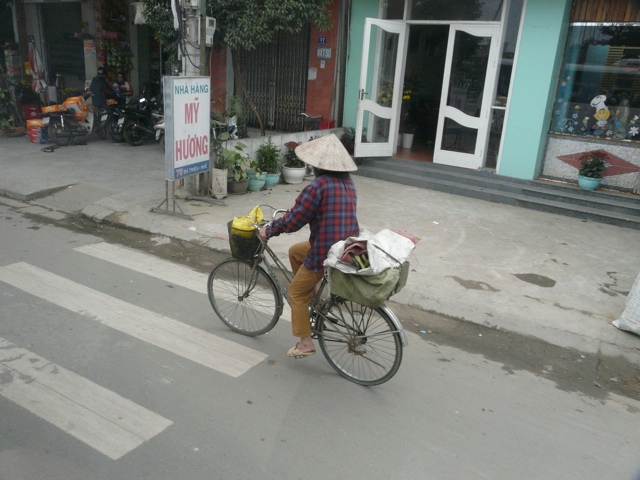
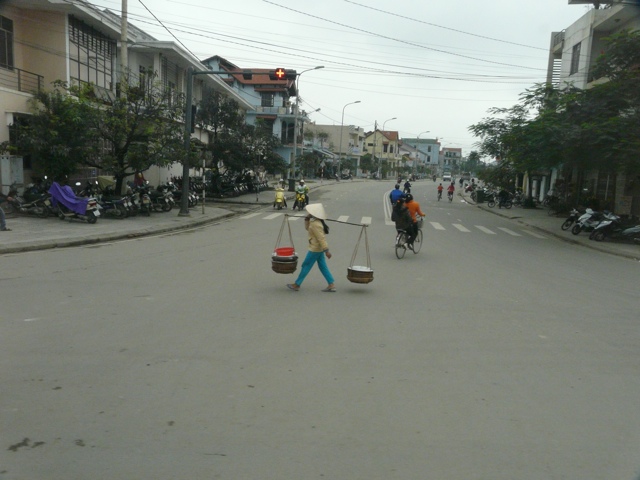
  Hanoi is 75 miles from the boat, a three hour drive with horns blaring, motorbikes everywhere and constant habitation along the way. The villages we go through are clean this morning, it looks like the sidewalks and roads were swept overnight. The markets are not yet open, people are washing their motorbikes or transporting goods to the markets. The mode of transporting goods is either a pole with a basket on each end balanced on their shoulder, or piled on a bicycle, or on a motorbike. We pass some women in orange jackets out sweeping the road. As we progress there are more signs of life –  number of women on bicycles balancing the day’s grocery shopping, markets opening, people sitting out at the little sidewalk coffee stalls, more traffic. 

Our first stop in Hanoi is the ” Hanoi Hilton”. It was originally built as a prison by the French. It was used for political prisoners. Totally black inside at that time. Prisoners were shackled on a concrete shelf one beside another, they could sit up or lie down. The prisoners that were signaled out for punishment were shackled on a slanted shelf in a small room, when they lie down their head would be below their feet. The French did torture their prisoners, we saw a couple of pictures and had brief description but the display was tasteful enough not to show that in any detail. The prison was originally built to house 500 people. During the Vietnam war American pilots that were  shot down were housed there, about 2000 men were there. 

According to our guide the French political prisoners were treated very badly, but the Americans held by the Vietnamese were treated well. There were a few men on the ship that would not go into Hanoi because they had been in the war here and didn’t want to see it. The guide told me that he had taken one man around who had been in the prison during the war and he cried the whole time.

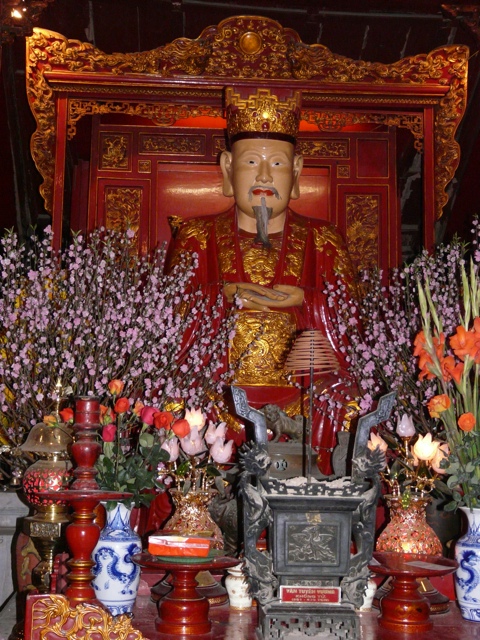
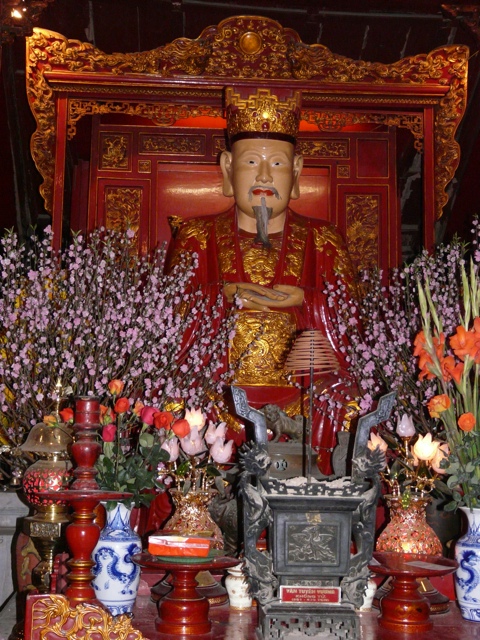
Our next stop was the Temple of Literacy, so named as it is the site of the first university in Vietnam, founded 1070. The Temple itself is dedicated to Confucius. There is an image of him and to the sides his four best students.  

Today students have to pass two exams to qualify for university. First they must pass a local exam and if they pass that they go to Hanoi to take the second exam. Assuming they pass then 3 to 7 years of university. If they study medicine, teaching, policing or to work for the government the tuition is $20 per month. If they study anything else the cost is higher. The best university has a $10,000 per year fee.

While teachers are honored their wage is low, $100 per month. As this is not sufficient to live on most teachers have a second job. The yellow brick buildings we pass are all government buildings or schools. Now usually both  husband and wife work. In 1993 the Government decreed that a couple can have only two children. If you work for the government and have a third child you will no longer be eligible for promotion. The government is worried there will not be enough food and things like access to education will be to be restricted so they are trying to manage the population size to ensure the people can all be looked after.

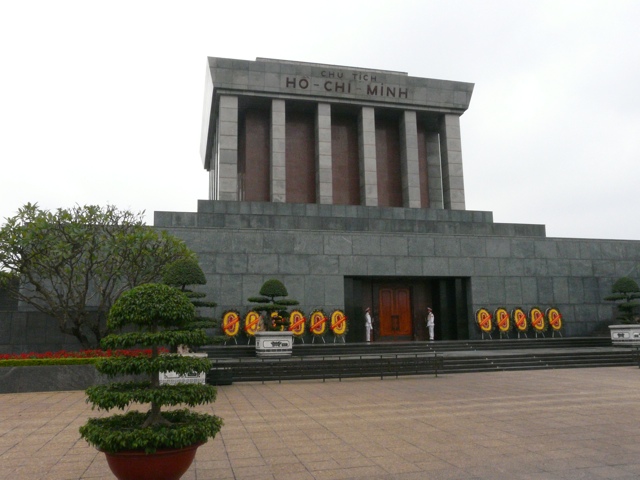
We then went to the Ho Chi Minh mausoleum. Ho Chi Minh is a cultural hero. He left Vietnam when he was 19 and travelled around the world for 30 years returning to Vietnam in 1945 after the Japanese left. Independence was declared and he was the first president. He brought the model of communism as his preferred political regime. He was president until he died in Sept 2 1969 of a heart attack. It was his wish that everyone will have a house, an education, a job and well being. When we first saw the mausoleum, Gary and I both had the same reaction – it looks like the open air area in Nuremburg where Hilter would gather the masses for his speeches. Apparently it also looks like Red Square in Moscow. The mausoleum is only open in the mornings to visit and there are usually long lines to get in so we were not able to visit. There were several guards and the gardens were cordoned off.

We heard the story of their flag. The red background  symbolizes blood, the yellow colour of the star represents the yellow skin of the people and the five points on the star are for workers, farmers, intellectuals, businessman and soldiers. The Presidential palace was designed as the homes of the farmers, a house on stilts, as the President wanted to live like the average person did. We did not see the house.
He loved to garden and kept a garden at his home – a simple and modest man we are told.

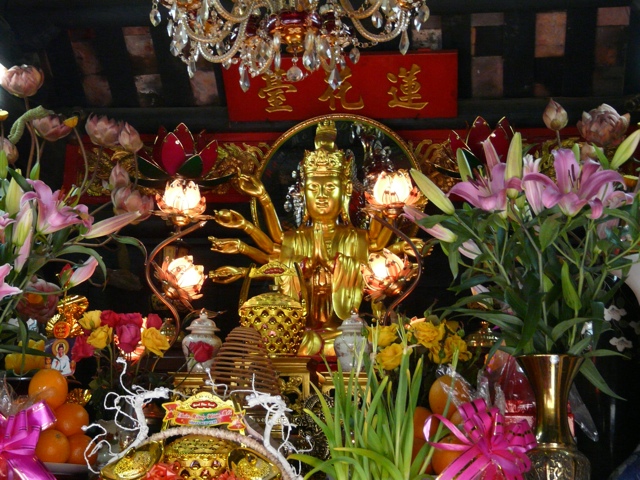
We next saw a small pagoda that had ben originally built in 1049. Inside was a lady Buddha, she has 1000 eyes and arms, which allowed her to look after all her people.

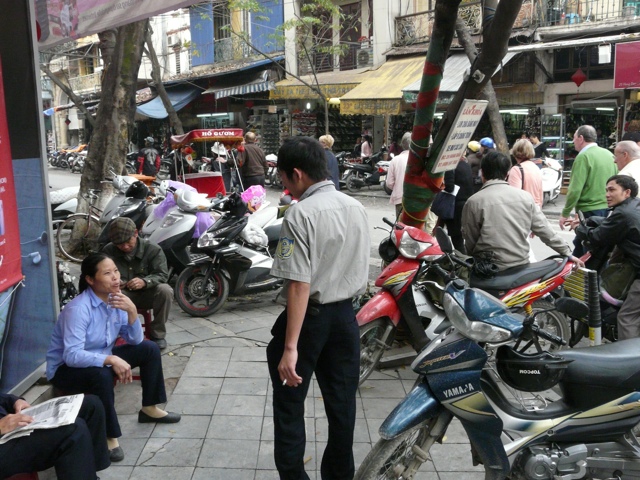
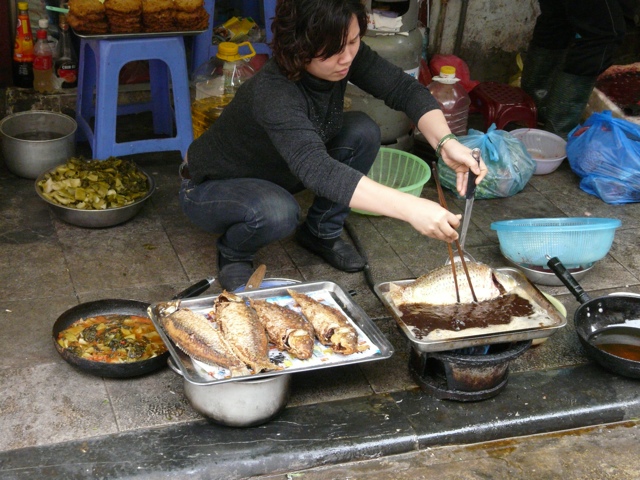
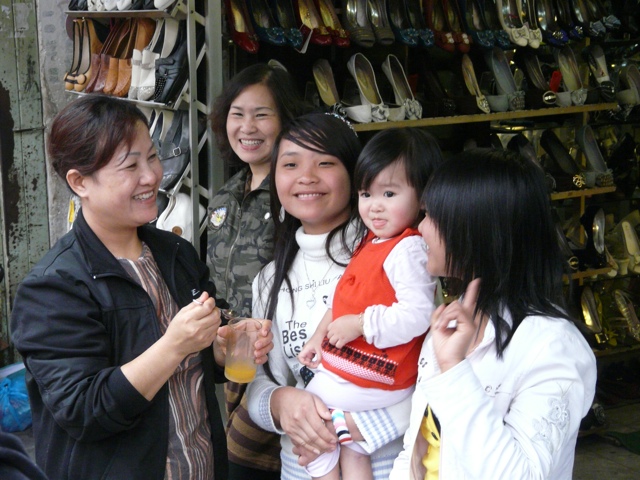
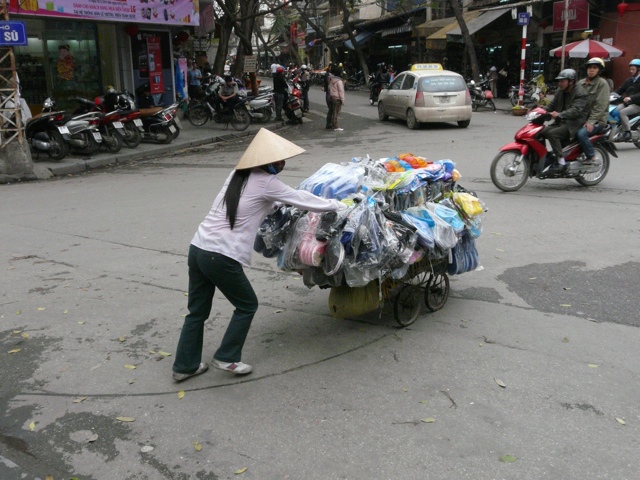
Our last stop was the old part of the city which has an extensive market. You can buy anything you want there and if they don’t have it they will make it for you. The market is along narrow streets, lining both side with goods spilling out of the tiny shops onto the sidewalks. People are sitting on the tiny chairs they use eating, drinking coffee, butchering meat, peeling shrimp, cutting up fish, sorting their veggies, trying on shoes, making shoes etc etc. Each small shop has it’s own specialty there are no supermarkets or department stores. People use any method they can to transport goods, anything but trucks that is. We don’t see many trucks at all.

In 2010 Hanoi celebrated its 1000 anniversary. There were various decorations and other evidence of the celebrations around. To commemorate the event a wall 3.5 kilometers long was constructed and decorated with with a ceramic mosaic. The wall follows along on of the main roads.

Hanoi has more cars than other cities we have visited in Vietnam, combine this with at least as many motorbikes as everywhere else, the constant horns and the normal driving techniques it was an interesting travel day. There are not as many traffic lights as we are used to and I and not sure how the corners really worked. You need to be a very aggressive driver in order to get anywhere. Usually the bus would go around the block to drop us off instead of risking us walking across a road. I did see crosswalks marked but I didn’t see that they were used regularly or that drivers even knew they were there. 

On our drive into and back from Hanoi we stopped at an embroidery factory. The work is done by children and we are told that these are disabled children of people who were affected by Agent Orange during the war. The quality of the work is not as good as what we had seen a couple of days ago. The shop also sold jewelry made from stones mined in Vietnam. There were some beautiful star rubies and star sapphires. I didn’t get anything – expensive!

There is construction going on everywhere and some of the construction techniques look a little suspect, especially things like bamboo supports propping up walls. The usual rat’s nest of wires everywhere. 

We did try to buy some Vietnamese coffee, at the market we asked one woman about her coffee beans. They were in one kilo bags, she said $45. We didn’t buy any and the guide said it should have been about $15 and she would have bargained with us.

Tomorrow a day at sea on our way to Hong Kong.

Posted in Uncategorized | 1 Comment

Feb 23 Ha Long Bay

Feb. 23 Ha Long Bay

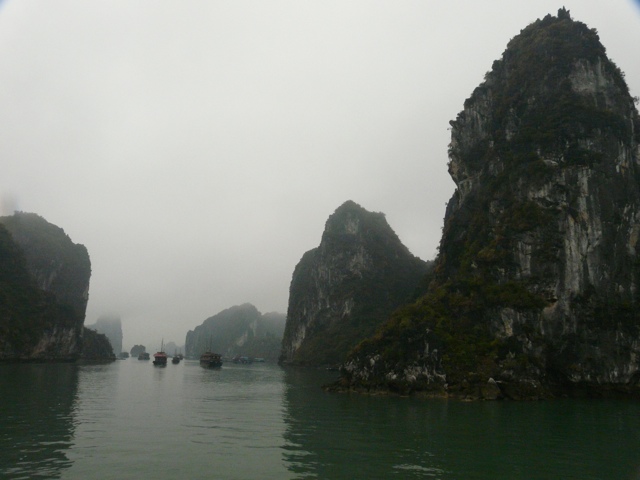
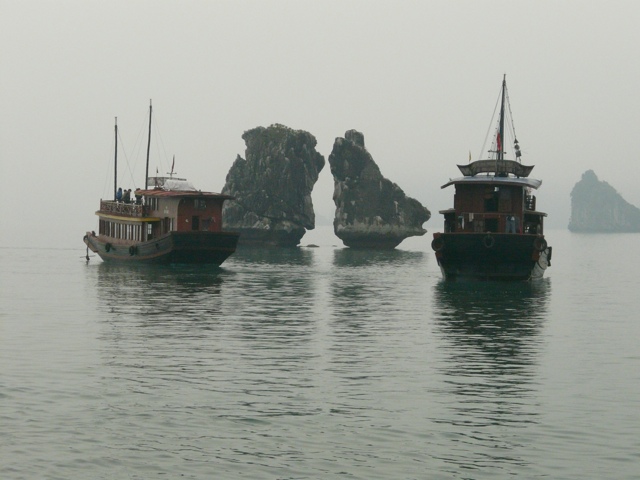
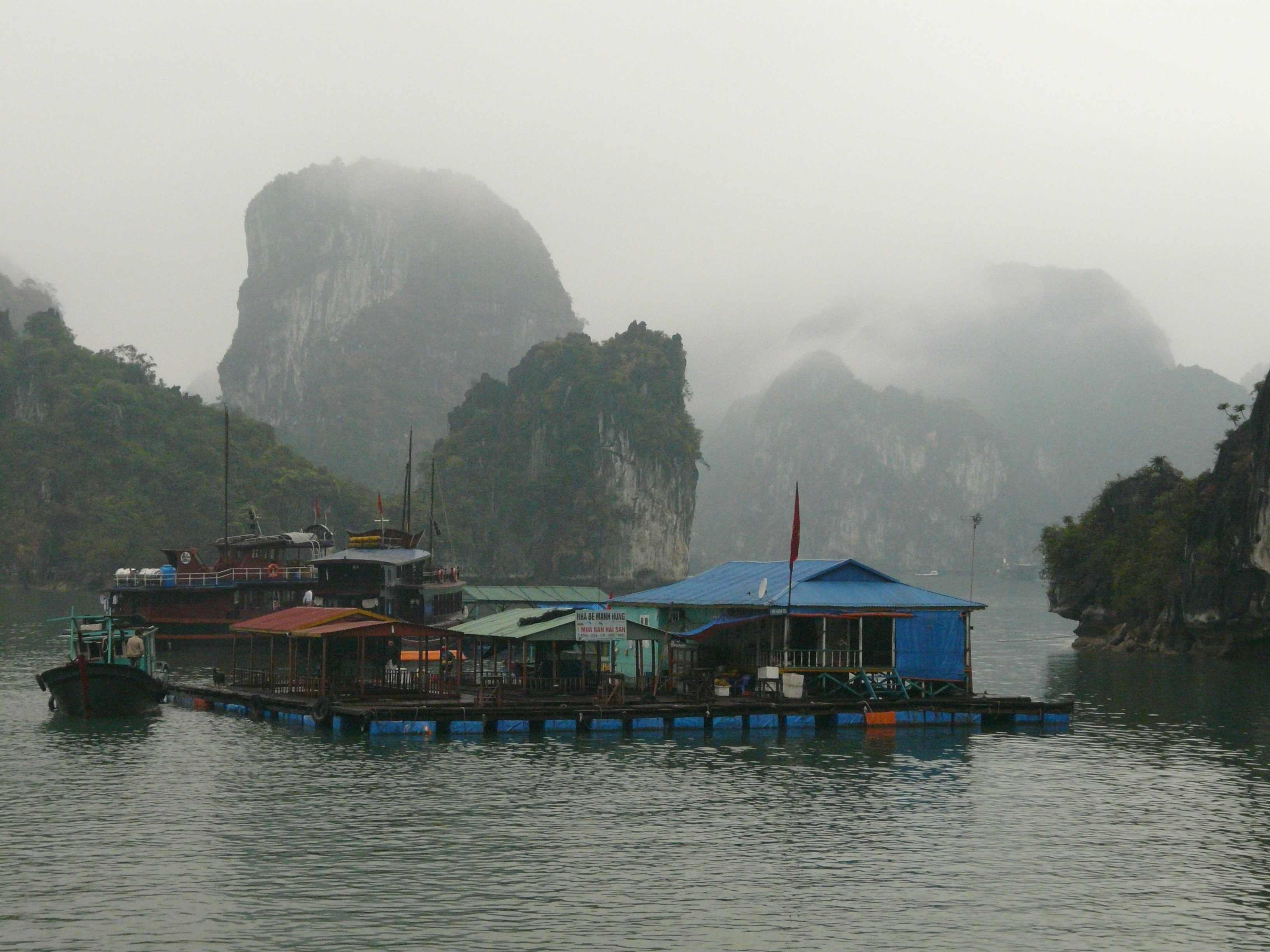
We arrived in Ha Long Bay this morning. Unfortunately, it is foggy, but we can still see the rock formations which leap straight out of the water. There are many of these rock formations about 1969 and 900 are large enough they have been named. The islands are named for their shape or history. Some of the islands are inhabited.

To complicate matters in the fog there are many large cargo ships and small fishing vessels. The large ships often have a series of smaller cargo ships lined up beside them for loading and unloading as they cannot get into the dock. We are actually 75 miles from Hanoi here.

Ha Long is the busiest port in the north. Mountainous area and major coal mining area. The local city is divided by the river and connected by a bridge and ferries. We took a bus to Bay Chay Beach. There are several large new hotels.  This is becoming a major tourist area with lots of foreign investment. A house in this area would cost about one million US dollars. It sounds like there is a lot of Taiwan and Japanese money being invested here. Lots of high end  hotels being built. It looks like they are preserving that water front. There are restaurants , the night market and walkways along the waterfront, the hotels are being built across the road from the water on hills, so good views.

Most boats we have been on use the “Oakville”  docking method. Some of you will remember this as aiming the front of the boat at the dock and hitting the dock with your bow. Luckily these boats are built for this with a square front the passengers can walk off and no pieces of fiberglass fly off!

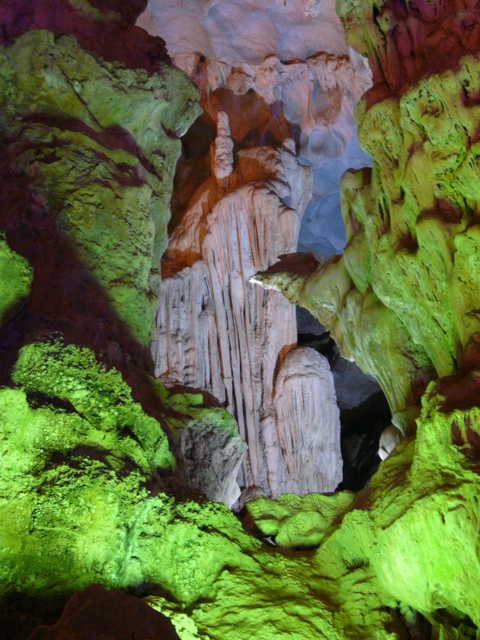
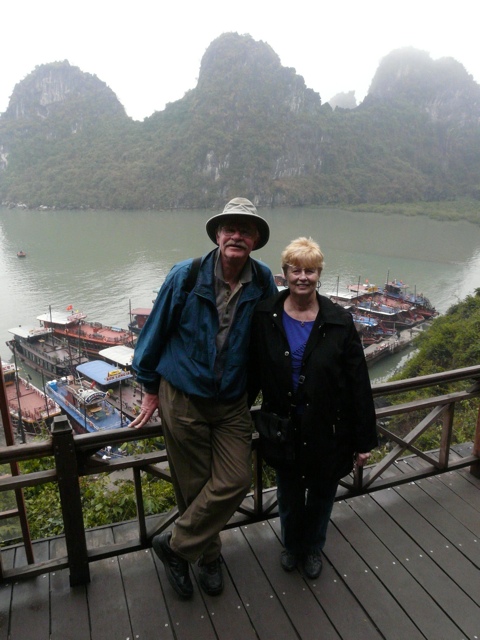
The bay is amazing. Despite it being a foggy day we see the islands rise out of the water all around us. It is a very active bay with many boats – tourist boats, fishing boats, large ocean going cargo ships, fish farms, boats selling produce. We had a stop to visit the grotto. The grotto is basically a hugh cave. The cave was discovered in 1995 and opened to visitors in 1998. Of course there is a legend about this as well. The dragon prince fell in love with a lady from the sea. The cave was the location of the wedding. Wedding guests included all the animals and the cave was decorated with many flowers. If you used your imagination you could see some of the animals in rock formations. The dragon prince and his wife had 100 children who are the ancestors of the Vietnamese people.

90% of the islands are limestone, formed by a process called Tectonic Mark Down (I think Ross will need to research that one for us). The bay survived the war as the Americans made a conscious decision to not bomb the bay. They had mined it and came in when the war ended and removed all their mines themselves.

See some interesting ways of doing things. We passed 2 young men on a motorbike. The one riding was sitting on the bike facing backwards and pulling a wheelbarrow with a green garbage bag in it. They pulled up to the side of the road where there was a pile of garbage and without stopping he tipped the garbage bag out, they did a U turn and went back the way they came with him now pulling the empty wheelbarrow. All the people row boats backwards from the way we do it. Usually standing, they face the way they are going and push with the oar rather than pull.

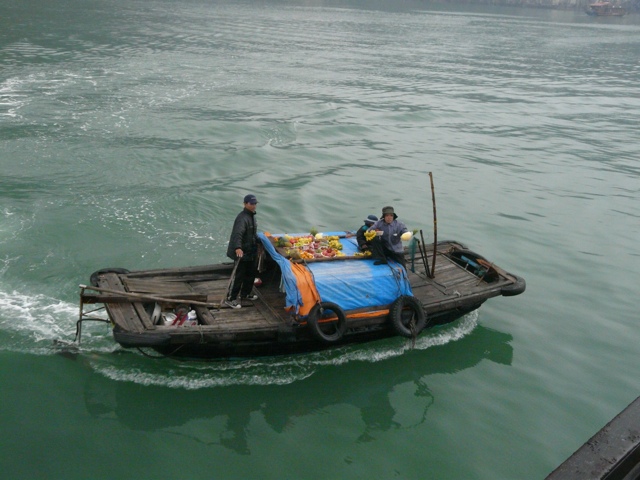
As our boat goes slowly through the fish farm areas several small boats pull along side trying to sell fruit. Each boat has a man driving, a woman on top of the boat with many bowls of fruit and one or two young children aged about 3 – 5. The woman climbs on our boat to sell the fruit and the kids sit on the top of their boat look cute and wave.

Posted in Uncategorized | Leave a comment

Ha Long Bay Pictures

Posted in Uncategorized | Leave a comment

Da Nang Pictures

Posted in Uncategorized | 1 Comment

Feb 22 Da Nang

Feb 22 Da Nang

We aren’t actually in Da Nang but at Chan May port. Today we went on a tour to the ancient capital Imperial Hue. 

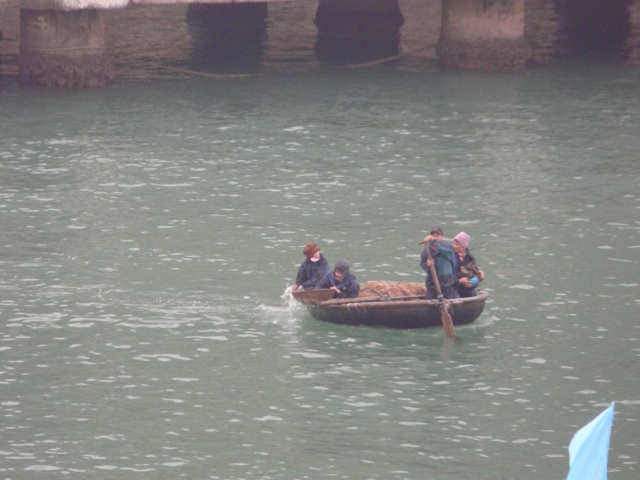
At the dock we saw some round boats, look like hugh half coconut shells that have been hollowed out. They are fishing boats, some with as many as 4 people in them. To propel the boats a rower stands at the front (no pointy end, so anyplace on the boat can be the front). We were told these boats are used to set the nets.

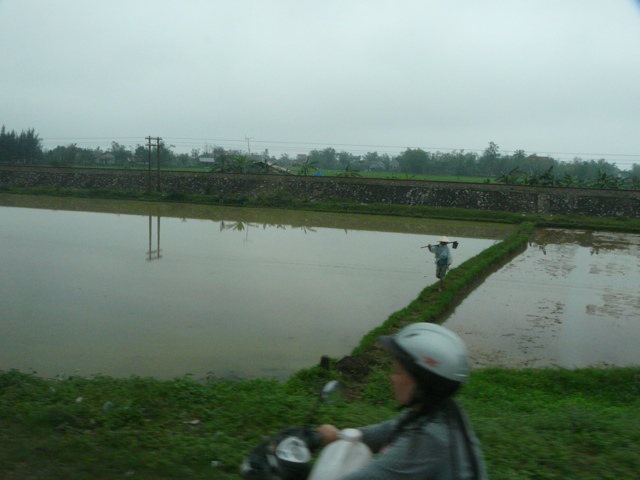
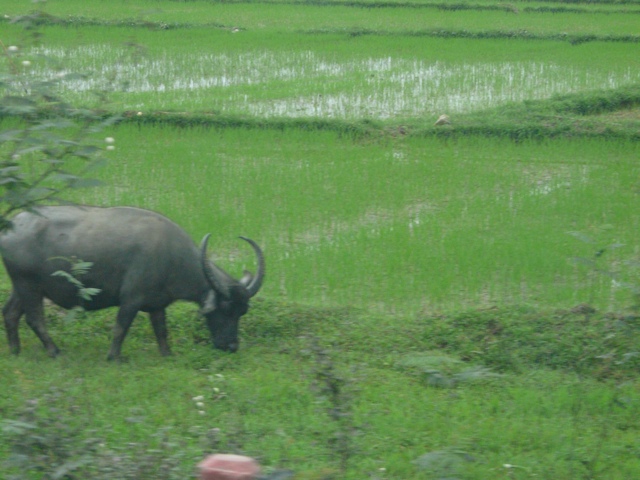
For about an hour and half we passed rice fields. There are many workers in the fields, most have on the traditional conical hats, their pants rolled up above their knees and are barefoot. We passed many water buffalo some just grazing and others pulling plows. Just like all the pictures we have seen over the years. At this time of year they are planting the young sprouts. They start the rice and then plant in rows in the flooded fields once they reach the seedling stage.

The farmer visits his field 3 times during each of 2 plantings. First to plant the seedlings (don’t know where those are started), second to  tend the baby rice and last to harvest. All this is done manually. To harvest they grab a few stalks and cut off the tops, looks like grain stalks with a “flower” at top. This is then dried in the sun for 3 or 4 days. Most fields have scarecrows to keep the birds away.

The other thing we see a lot of are cemeteries, they appear to be scattered all over. Some very elaborately decorated tombs. There is a lot of ancestor worship practiced in this area. We are not in North Vietnam yet but see more evidence of the communist regime – large signs, the communist flag.

We pass a large lagoon, which we are told is the largest in Asia. Brackish water with many fish farms. They are farming shrimp and prawns. The rice fields go right to the edge of the lagoons and there are dams to keep the brackish water out of the fields.

Another sight we pass is a monk who is walking from the south of Vietnam to the north. After we get back on the ship we learn that there are various storied about his trek. Putting it all together is seems he was a physician, he made some error that resulted in people dying and this trek is his penance. People line the road to see him pass. He is in the traditional robe (however, I think the wool hat is not part of the original dress). Some one walks before him and puts cloths on the road for Hume to walk on. Every 3 steps he gets on his knees and bows his head to touch the ground- this will take awhile! He started sometime in 2007. He stops each night and stays at the nearest pagoda. Behind home in a line are 20 or so women, in grey robes who follow him. I don’t  know how far each group follows him. He is barefoot. One story is that he will kill himself by setting himself on fire when he reaches the end of his journey. People along the way bring him food and water.

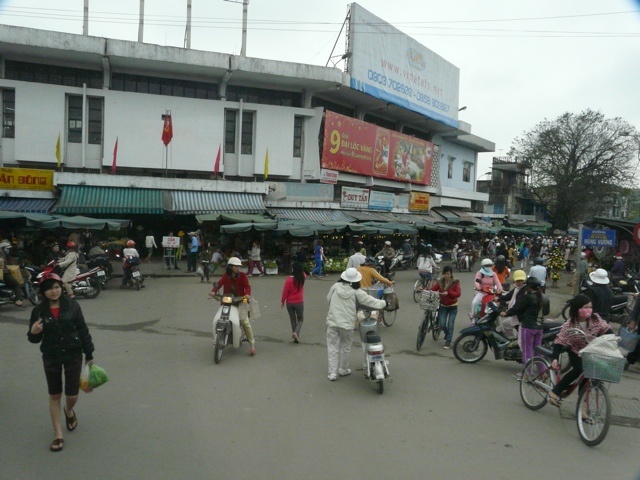
The road we are on is a two lane basic road in need of repair and is the only highway connecting the north and south. We go through village after village. Many with the daily market in progress. When one vehicle is passing another they blow their horn. Still at lot of motorbikes, more motorbikes than cars. The ride itself is an adventure. At one point our bus pulls out to pass a truck, it seems there is barely room, especially when you consider the oncoming motorbike traffic. As we are beside the truck another local bus passes us! There are the usual lines on the road to mark lanes, but they appear to be there for decorative purposes only.

Most people we pass and our guide are all bundled up. Our guide has on a long sleeve shirt, a turtle neck and a parka with a fur lined hood. It is about 75F and they are all complaining of the cold! 

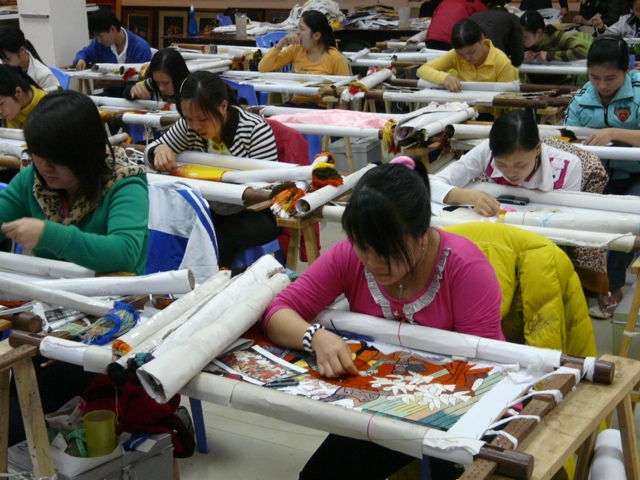
We stopped at an embroidery factory. All hand work. Several women work on one piece at a time. The silk is stretched over a work area and as many as 4 women work on one piece at a time. They are making large scale wall hangings. The work is beautiful and they appear to be working winging a pattern. There is a design sketched onto the silk, but they will draw new lines or adjust the design with a pencil as they go. The stitch is different from the embroidery stitch I was taught.

The whole area is dusty and dirty with garbage everywhere, the only cultivated areas are the rice fields, so the dust in the towns and along the roads is thick. The usual pollution, so people still often wear masks over their nose and mouth.

We are told 20% of the population are Buddhists, most are ancestor worshipers, some Catholics and communique make up the remainder. In order to get a government job such as teaching you have to be a member of the communist party.

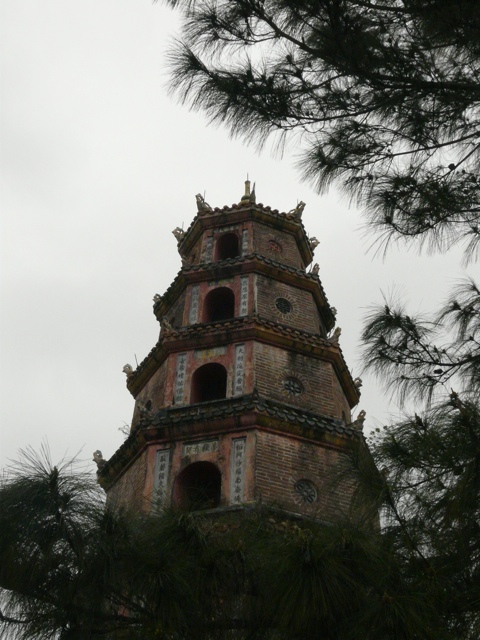
Our second stop is the Lovely Lady Pagoda. The name comes from a story that a lady once lived at the top of a palm tree at this location and predicted that a temple would one day be built there. She disappeared every night and reappeared in the morning. Inside a small chapel a man in regular suit was kneeling before the alter, behind jim was his family. He was holding a large bunch of indents in his hands. He would chant, a boy in his monks outfit would hit a large gong and everyone would bow their heads to the ground.

The pagoda is home to a group of monks, some young boys. They tend the pagoda and teach the boys living there. One of the sights we were shown was the car the monk drove to Saigon to burn himself in the centre of the city. I remember seeing that image on TV at the time. He was protesting the lack of religious freedom.

Our next stop is the large citadel. A large area enclosed by a high 10 kilometer concrete wall. Inside is the Imperial palace that housed the monarchy for a thousand years. To get into the citadel we had to cross a narrow bridge on foot and go though an opening in the thick wall. On this one lane bridge was 2 lanes of walkers, one on each side of the road, motorbikes about 3 or 4 across, the occasional car and bicycles. Our guide told us to cross a road you must walk slowly, don’t stop, don’t change pace so the motorbikes could go around you. Any change in your pace resulted in the bikers getting confused and this caused accidents. Pedestrians had no right of way even on the crosswalks.

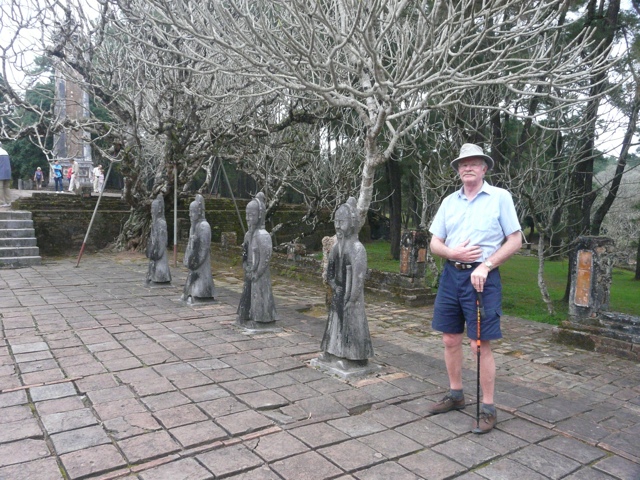
Inside the palace the first section is a large outdoor reception area. He the king would receive his mandarins, they would assemble according to their rank. Nine ranks and a total of 500 mandarins. Gary had his picture taken beside a row of statues of the mandarins – he is about twice their height! The next area is the forbidden city where only the king and his family could enter. There is some French influence seen in the architecture. After the last king left there has not been any attention paid to the facility, although they are now starting to restore it to promote it as a tourist area. The last king lived here until 1945 when he abdicated.

We had a Vietnam lunch at a modern hotel. We were greeted by some dragon dancers and were entertained by traditional music during lunch.

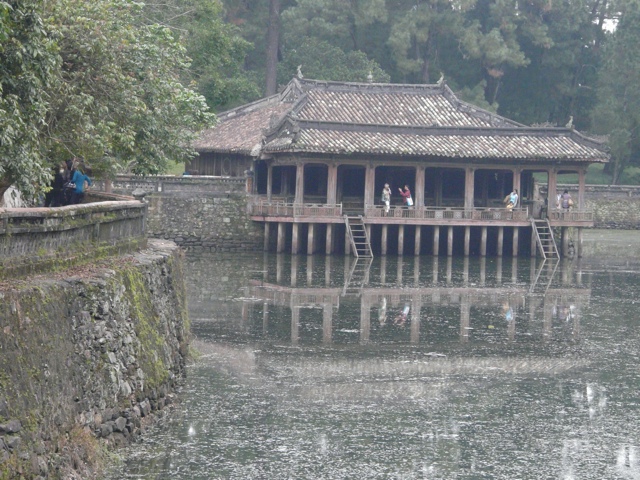
The last stop was at the tomb of King Tutuc. It was more of a summer palace. He spent the summer here, he was the last king and was unreality a puppet king as the French ruled Vietnam at that time. He was not skilled at war and came here to fish, hunt and write poems. He wrote 4000 poems during his lifetime and moved to       Paris when he abdicated.

The grounds are extensive, including the family’s living quarters, their temple and burial grounds. The Chinese ruled what from the first to tenth century, then the Chinese retreated and there was a monarchy in place until 1945. It was ruled by the French from 1802 until 1945. What is now called South Vietnam was part of Cambodia or Laos for much of the time.

Posted in Uncategorized | Leave a comment

Feb 21 Cruising the South China Sea

Feb 21 Cruising the South China Sea

A day of rest. Gary went to gym this morning and hurt his back. Hopefully he will be better tomorrow. There is a fresh breeze which is a big relief after the heat of the last week. All week we have been in temperatures of 35C and over with high humidity. Thank heavens the buses have all been air conditioned and carry lots of cold water. Most buildings are not air conditioned and it sounds like very few houses are.

Impressions of Vietnam: 
Still a lot of poverty but we didn’t see people begging, the same in Thailand. There were lots of street vendors selling polo shirts, watches, postcards – the usual stuff.
The motor bikes are overwhelming, they seem to take endless risks both in their driving habits and in what they pile on the bikes. The cadillac of motor bikes are the Japanese scooters. There are a lot of Chinese built bikes as they are the cheapest. Our tour guide was very proud that he had recently been able to afford to buy a new Honda.

At least half the people on the bikes wore bandanas to covert their mouth and nose. Mostly for protection from the pollution, most wore helmets. The law requires the wearing of helmets and most adults comply, but they often had their kids on the bikes with them and no protection. We often saw families of four on the bike, some of the smaller children would be standing especially in front of the driver. A few times we even saw women with a small baby in their arms. We saw many close calls but no accidents.

The main streets of Saigon are well laid out. Large boulevards with a green space down the middle, also a number of small parks scattered around.

Average wage is $400 per month in the city and around $200 in the country. Jobs in the tourist trade, government and for foreign companies pay the best, around$1,000 per month. Cheap bikes sell for $500 and Japanese bikes for $2,000 ($1,000 used).

All land is owned by the government but people can own their houses. In the city they pay by the square meter about $3,000 for one square meter. Most workers live in the suburbs. Rent for an average flat in the city is $1,500 per month, so need two wage earners to afford to live in the city.

One difference we noticed is the horns and noise in the city. Very different from Thailand. Also Saigon is very dirty with trash everywhere.our guide said they sweep the streets every night, but I find that hard to believe.

Most of the population is Buddhist with about 5% Muslim. Both Vietnam andThailand are considered safe for tourists and I certainly felt we could have wandered around most places on our own. Like most large cities in the world we were cautioned about pick pockets and were advised to take off any jewelry.

They do believe that if they get to North America they will be rich. Relatives that emigrate send money home to help support their family here and it sounds like that creates some problems as the people here then think they don’t have to work. The young families are smaller now and parents want to ensure their children go to school.

The medical sounds very bad. Few hospitals, crowded, few doctors, no nurses. There may be 30 people in a room with 10 beds. Family members have to stay with the sick to care for them. The family sleep under the bed while three patients may share the bed! There are some god hospitals in Saigon but as the medical care is not free most people can’t afford these hospitals. They often cant afford any care.

Seventy percent of the land is still forest and it is quite mountainous.

The people are tiny, especially the women. We are giants by comparison. We often see people in traditional dress, conical hats. A lot of the women wear scarves over their faces, gloves, long sleeves, long pants or dresses. They want to have pale skin and go to great lengths to avoid the sun, I can’t imagine how hot they must be.  Most people appear well dressed. Did see a lot of men smoking, not many women.

Speaking of dress, I missed the memo about the dress code on the ship. All the brochures call for country club casual – for a lot of the women that meant Jamie Saddock (a designer of womens golf wear). I missed that boat! With the amount of her designs on board she could open a store.

Schooling is a big issue for young families as they see that as the wY for their children to get ahead ( and subsequently support them ). Primary schooling is free, high school and college/university is not free. By our standards it is cheap at $2,000 per year for tuition but parents have to be diligent to be able to afford it.

Posted in Uncategorized | Leave a comment